ChillTest: Cooler Ice Time
Your cooler says it holds ice for days. Weigh the meltwater and find out what it actually does.
Download on the App StoreFeatures
One number for your cooler
Load it with ice, leave it a few hours, then weigh the water that has collected. ChillTest converts that into a single heat-leak figure in watts per degree, which belongs to the cooler itself rather than to the day you tested it.
Measured, not estimated
While ice is melting, the inside of a cooler sits at 0°C, and melting a kilogram takes a fixed 333.55 kJ. Every gram of meltwater represents a known amount of heat that got in, which is what makes this a measurement.
A kitchen scale is the whole kit
Nothing to buy, nothing to pair, nothing left inside the cooler. A measuring cup works just as well if that is what is in the drawer.
Answers for the trip you are packing for
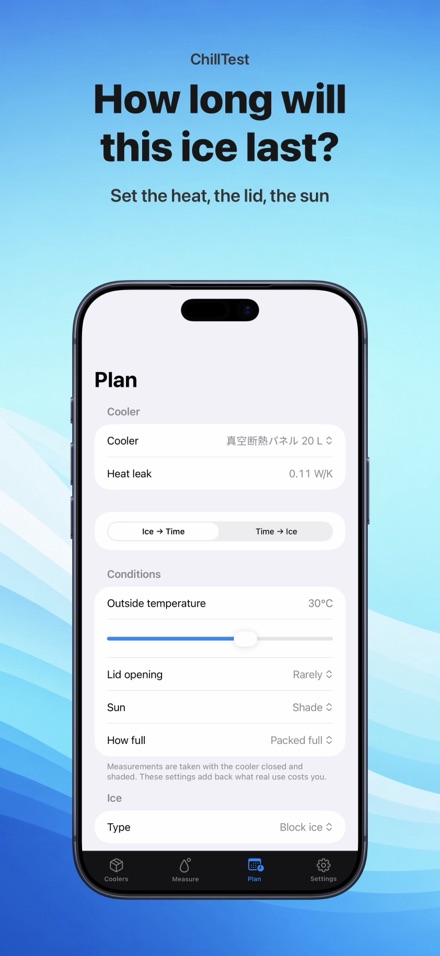
How long 5 kg of ice lasts at 30°C, how much ice a weekend at the cottage needs, whether the expensive cooler really doubles the cheap one. Account for lid opening, sun and how full the cooler is packed.
It refuses to show a wrong number
If the ice melted out, if ice packs were used in place of ice, or if it was barely warmer outside than in, the run is not a valid measurement and no figure appears — just an explanation of what to change.
Rank every cooler you own
Keep as many coolers as you like, each with its own measurement history, sorted best first. The ranking comes from your conditions, not from a spec sheet.
Every cooler is sold on ice-retention days. ChillTest lets you find out what yours actually does — with a kitchen scale and a bag of ice.
No thermometer. No sensor to pair. Just meltwater on a scale.
HOW IT WORKS
While ice is melting, the inside of a cooler sits at exactly 0°C. That turns the meltwater into a measuring instrument: every gram that melts stands for a known amount of heat that leaked in. Weigh the water, tell ChillTest how long it sat and how warm it was outside, and the app works out one number for that cooler — its heat leak, in watts per degree.
That number belongs to the cooler itself, not to the day you measured it. Once you have it, ChillTest answers the questions that actually come up:
• How long will 5 kg of ice last at 30°C?
• How much ice do I need for two nights at the cottage?
• Is the expensive rotomoulded cooler really twice as good as the cheap one?
NOTHING TO BUY
A kitchen scale or a measuring cup is all you need. No thermometer, no sensors, nothing left sitting inside the cooler.
ANY ICE YOU HAVE
Block ice, cubes, crushed, frozen bottles — set the amount by weight, by volume or by counting pieces. Ice straight from a freezer is below 0°C and lasts a little longer; ChillTest accounts for that too.
IT TELLS YOU WHEN A MEASUREMENT DOES NOT COUNT
This is the part most guides skip. If the ice melted away completely, the cooler never held 0°C and the result means nothing — so ChillTest declines to show a number rather than show a wrong one. Same when the cooler was not pre-chilled, when the run was too short, or when an ice pack was used instead of ice. Every warning explains what went wrong and what to change.
COMPARE YOUR OWN COOLERS
Keep as many coolers as you like, hard or soft, each with its own measurement history. They sort best first, so the ranking is yours — measured in your conditions, not copied from a spec sheet.
WHAT YOU GET
• One performance figure per cooler, with an estimated range
• Ice-remaining curves for any temperature and any ice load
• Required-ice calculator for a target number of hours
• Adjustments for lid opening, sun and how full the cooler is
• A step-by-step measuring guide explaining why each step matters
• Metric or imperial, grams or ounces, °C or °F
• Works entirely offline; nothing leaves your device
GOOD FOR
Camping and canoe trips, weekends at the cottage, fishing and hunting, road trips, the ball game, and anyone deciding whether the next cooler is worth the money.
These are physical estimates for planning and comparison. Real trips vary with how often the lid is opened, where the cooler sits and what goes inside. ChillTest measures how quickly ice melts — it is not a food-safety device and does not tell you whether food is safe to eat.