 DewCast: Dew Point & Frost
DewCast: Dew Point & Frost
DewCast: Dew Point & Frost
Barometer-corrected tonight
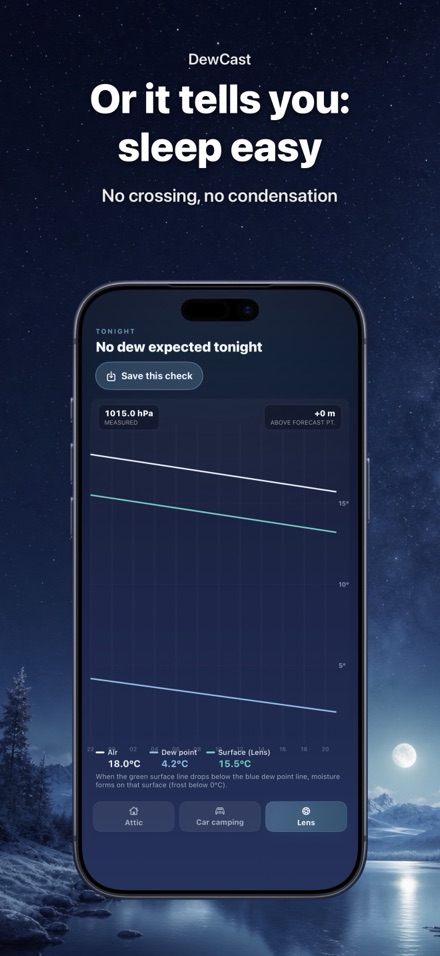
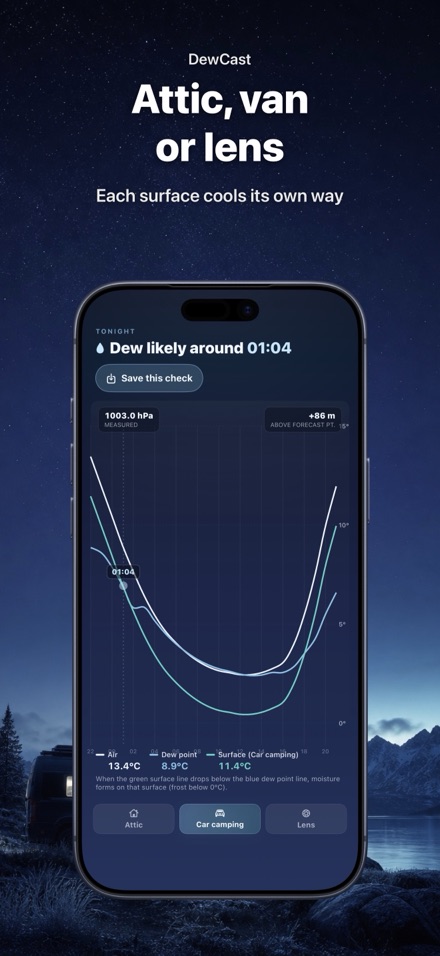
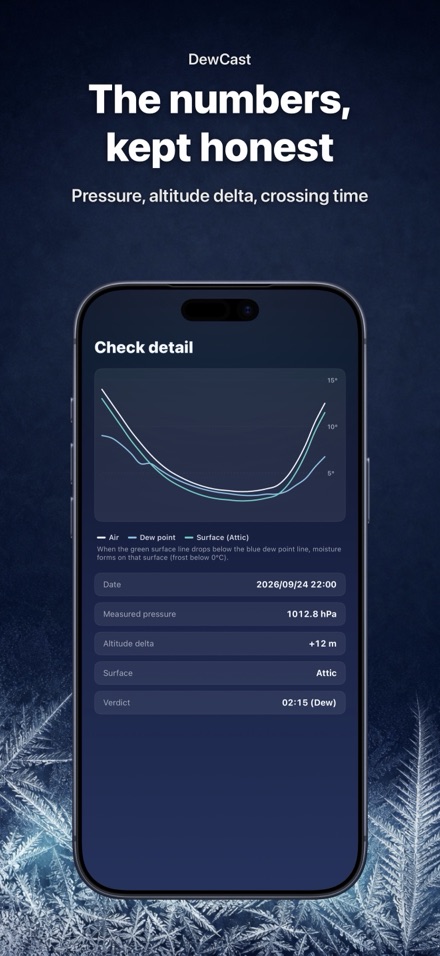
Download on the App StoreOpen the app and see a single time — 02:40, or 03:10, or never. A chart shows tonight's air temperature, dew point, and surface temperature lines. The crossing point glows; that's when condensation arrives. Below freezing, dew becomes frost — DewCast says which.
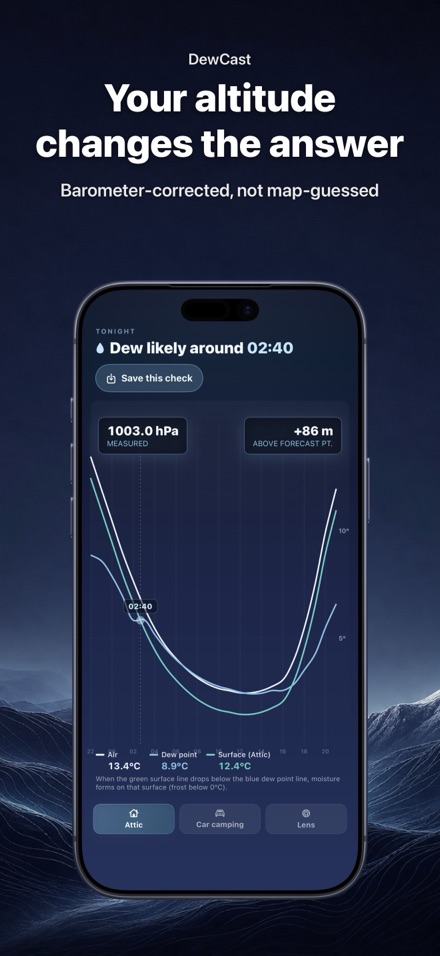
Every dew point calculator asks you to type in a temperature and humidity, then does arithmetic on paper values. DewCast measures instead. Your phone has a barometer. We read the actual pressure where you're standing — your attic, your van, your observing field — and correct the forecast for your real altitude. At the boundary where condensation happens, those few degrees are the whole answer.
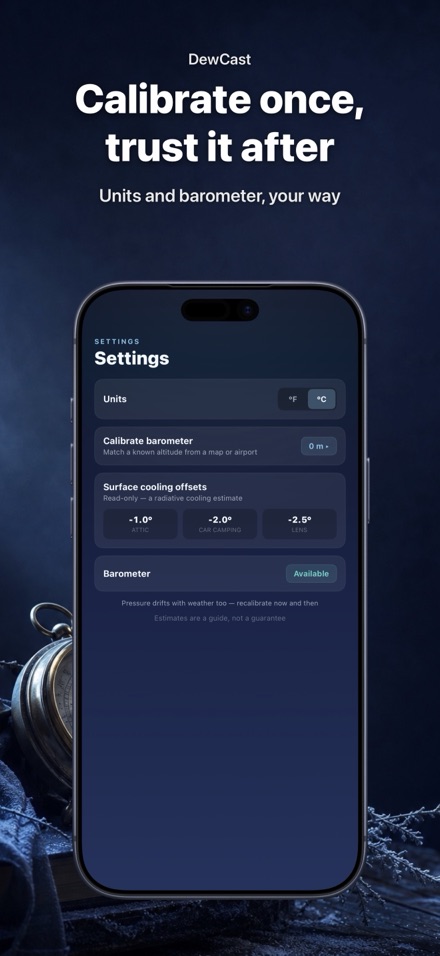
Switch between attic, car camping, and lens presets. Each surface cools differently after sunset — the app recalculates the crossing time instantly. No custom presets or material databases; three fixed surfaces cover the most common cases.
Weather forecasts come from a grid point that may be 100 meters above or below you. We use your phone's barometer to work out the difference, then adjust tonight's temperature and dew point curves accordingly. Manual calibration (match a known altitude from a map or airport) keeps the barometer honest.
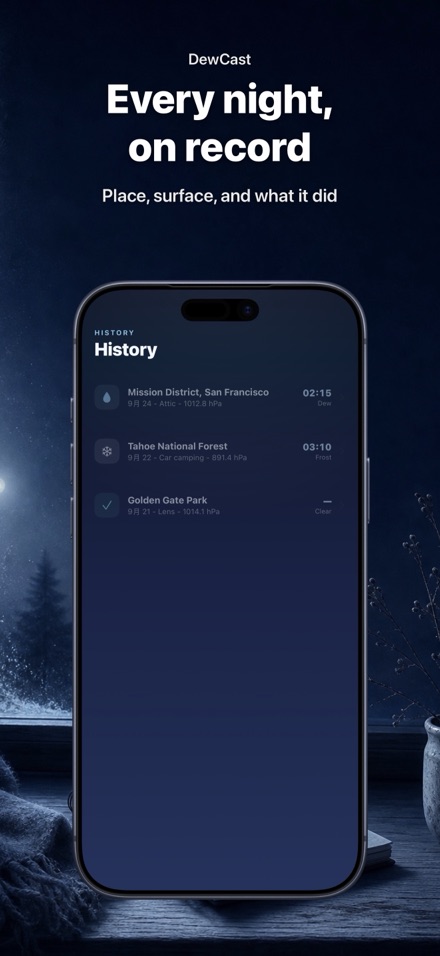
Save each check: date, place, surface preset, and the crossing time. View recorded data with the original graph, temperature numbers, measured pressure, and altitude delta. Search by place and date.
Pressure is measured on your device and can be calibrated manually. Temperature and humidity come from a free weather forecast (Open-Meteo). No forecast? The app says so instead of guessing. No account, no subscription, no analytics, no network connection except the forecast API.



The forecast is usually within ±1–2 hours. Your altitude correction adds a few degrees of precision at the boundary where condensation happens, but the forecast itself is the limiting factor. The app's estimate is a guide, not a guarantee. Real dew point depends on the actual temperature, humidity, and surface properties at that moment — factors forecasts can't perfectly predict. Always verify with your own observations.
Weather changes pressure. A low-pressure system moving in will raise or lower the reading by several hPa within hours. Calibrate the barometer against a known altitude (from a map or airport) periodically. If you're climbing a mountain, the reading will drop naturally. If you're watching from a fixed spot and the pressure drifts significantly in hours, weather is changing.
Yes, but the forecast applies to outdoors at your location. If you're checking whether condensation will form inside a building, the surface temperature may be different from what the app estimates. The app's prediction is for outdoor conditions at the coordinates it uses. Test it against real observations and adjust your expectations accordingly.
The app will say so and show the last known forecast (with a timestamp). DewCast doesn't guess or fall back to old data without telling you. To use the app fully, you need internet access when you pull the forecast. After that, the app works offline for checking and logging.